
This era was, on one hand, a religious conflict between settling Muslims and traditional Christians, between nationalities they represented, and, on the other hand, between feudal lords on power over the central government.Some historians date the murder of Iyasu I, and the resultant decline in the prestige of the dynasty, as the beginning of the Ethiopian Zemene Mesafint ("Era of the Princes").
The first verifiable kingdom of great power to rise in Ethiopia was that of Axum in the 1st century CE. It was one of many successor kingdoms to Dʿmt and was able to unite the northern Ethiopian Highlands. A bronze scepter or wand has been discovered at Atsbi Dera with an inscription mentioning "GDR of Axum". Coins showing the royal portrait began to be minted under King Endubis toward the end of the 3rd century CE.
Between 1528 and 1540, the Adal Sultanate attempted, under Ahmad ibn Ibrihim al-Ghazi, to conquer the Ethiopian Empire. Entering, from the low arid country to the south-east on pretext of a Jihad, encroached upon much of the Ethiopian plateau, forcing the Emperor to take refuge in the mountain fastnesses. In this remote location, the Empress turned to the Portuguese for military assistance against Ottoman guns.
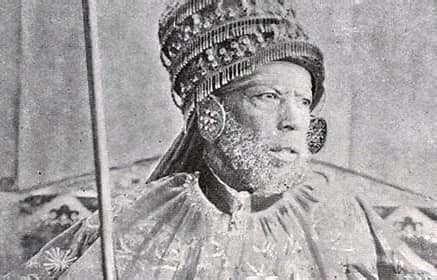
Menelik II Ge'ez: ዳግማዊ ምኒልክ dagmawi mənilək; horse name Abba Dagnew (Amharic: አባ ዳኘው abba daññäw); 17 August 1844 12 December 1913), baptised as Sahle Maryam (ሣህለ ማርያም sahlä maryam) was King of Shewa from 1866 to 1889 and Emperor of Ethiopia[nb 2] from 1889 to his death in 1913. At the height of his internal power and external prestige, the process of territorial expansion and creation of the modern empire-state was completed by 1898.